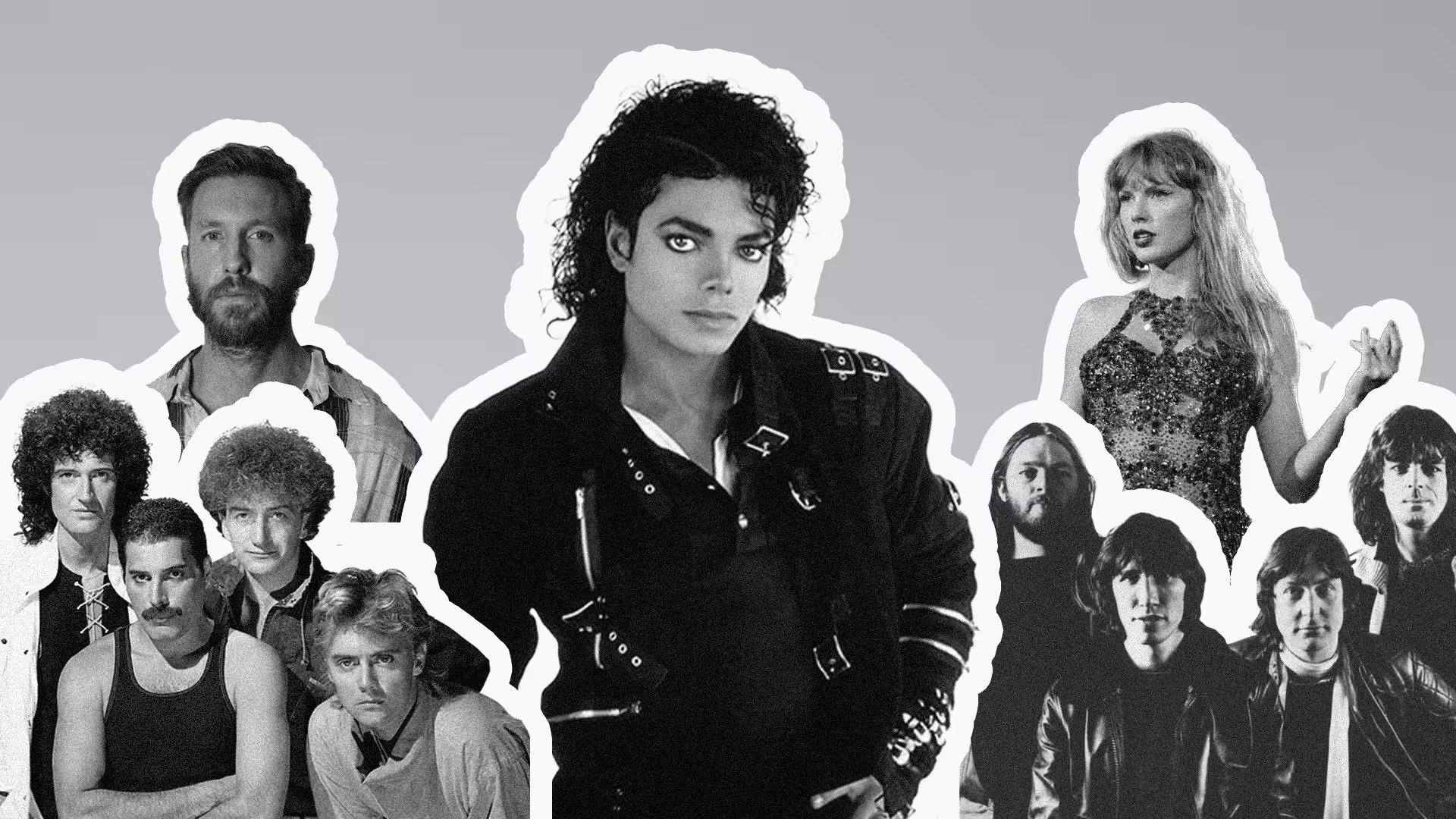
The most-streamed song on Spotify worldwide in 2026 came out in 2022: End of Beginning by Djo. It is not an isolated case: the year's global chart also includes Michael Jackson's Billie Jean and The Police's Every Breath You Take, two songs released more than 40 years ago.
These comebacks reflect a deeper shift. In 2026, nearly one in two streams among the 200 most-streamed songs on the planet goes to a song released more than three years ago. A year earlier, it was fewer than one in three. The trade publication Music Business Worldwide analyzed the trend in a study published in October. We draw eight takeaways from it, compared with listening data from our own catalogs and with comments from our team.
The scope of the study
Every week, Spotify publishes a list of the 200 most-streamed songs in the world, and another for the United States. Music Business Worldwide (MBW), the go-to publication for music industry professionals, founded by Tim Ingham, gathered all of these charts for the first nine months of 2024, 2025, and 2026. That makes 234 charts and 46,800 entries, compared track by track.
To sort these songs, the study applies the rule record companies use in their own accounts. A track released less than three years ago is a new release. After that, it joins what the industry calls the back catalog, meaning everything released before. This is the definition used by Universal Music Group, the largest record company in the world. A song released in June 2023 therefore counts as a new release until June 2026, then joins the back catalog.
The Top 200 does not show all listening. It shows the most visible part of it, the songs millions of people play every week, and that is often where changes in habits appear first. Where relevant, we compare these figures with those of our own tracks, measured by Luminate, the data company that also supplies the data behind the Billboard charts.
1. One stream in two, up from one in three last year
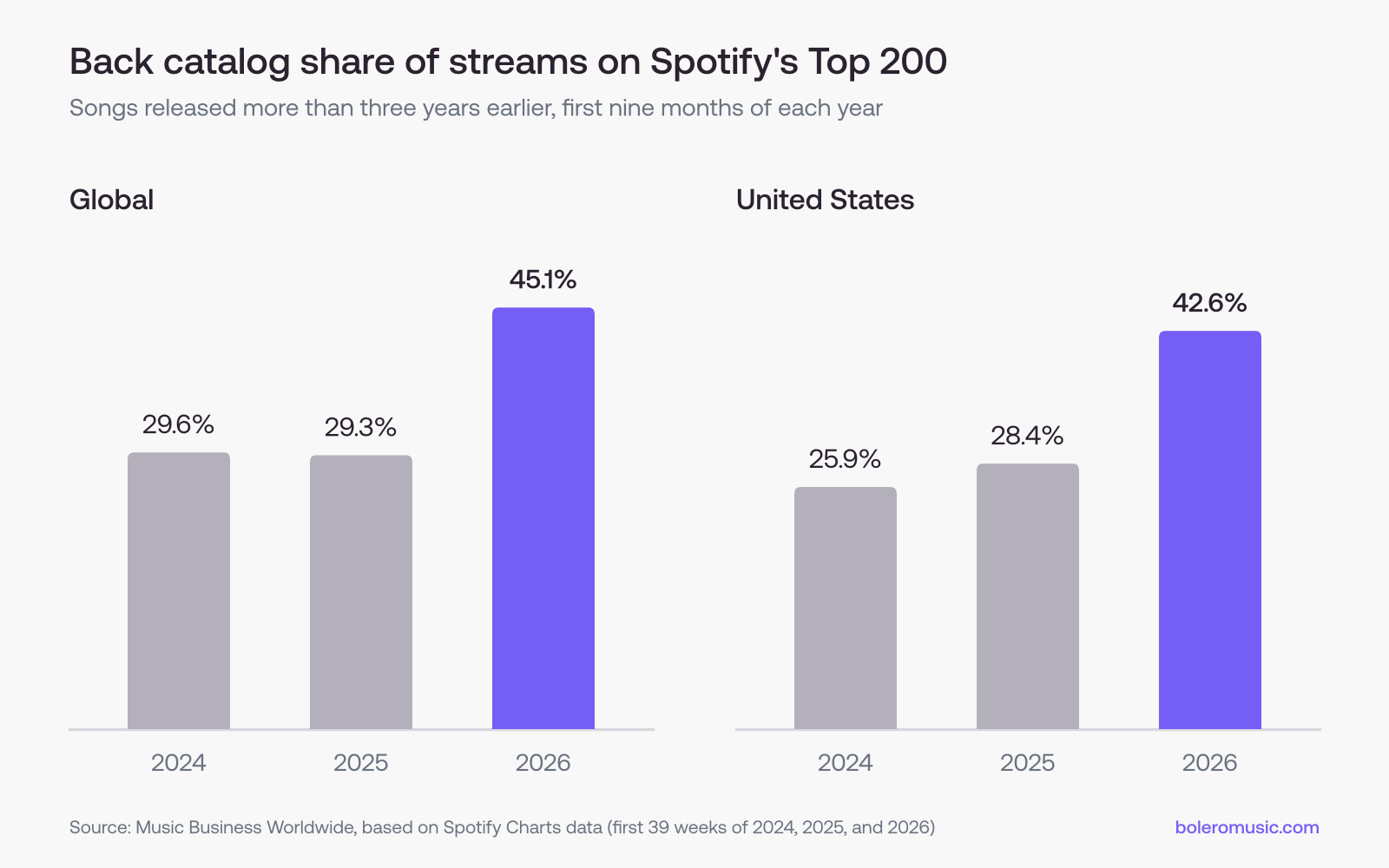
In both 2024 and 2025, songs more than three years old accounted for just under 30% of streams on the global Top 200 (29.6%, then 29.3%). Over the first nine months of 2026, their share rose to 45.1%. The United States followed the same curve, from 28.4% to 42.6%.
A share can rise simply because everything else falls. Here, the two movements add up: older songs are streamed more, and new releases less. On the global chart, back catalog streams rose 49% to 44.5 billion, while new release streams fell 25% to 54.2 billion. On average, 99 of the 200 tracks on the global chart each week were more than three years old, compared with 72 a year earlier. In the United States, new releases lost about 5 billion streams in a year, a decline in absolute terms and not just as a share, as Tim Ingham points out.
MBW's analysis rules out a Taylor Swift effect. Her return in 2026 actually slowed the trend slightly: without her tracks, the back catalog's share would reach 45.6%.
"The top of the charts long worked like a radio playlist: one hit pushed out the next. What MBW shows is listening that accumulates. Each year's hits add to those of previous years instead of replacing them. The direction of travel will surprise no one in the business. Its speed surprised everyone, including us." - William Bailey, CEO
2. Classics climb all the way to the top
Older songs long occupied the lower part of the chart, leaving the top spots to new releases. That was still the case in 2025: the back catalog accounted for just 0.8% of streams in the global Top 10. In 2026, it accounts for 30.9%. In the Top 50, its share rose from 11.5% to 30.8%.
The year's ranking confirms the shift. Seven of the 25 most-streamed tracks in the world are more than three years old, compared with two in 2025. Alongside the No. 1, End of Beginning (2022), are Billie Jean (1982), Every Breath You Take (1983), Iris by the Goo Goo Dolls (1998), and Justin Bieber's Beauty And A Beat (2012). New releases have not left the top, but they now share it with songs that have spanned several generations.
3. Songs 10 years and older drive most of the increase
Three years is a practical line, but it puts a 2022 hit and a 1982 hit in the same box. So MBW sorted the older songs by age, and the result is clear. Globally, tracks 10 years and older account for 32.4% of Top 200 streams, up from 15.4% in 2024. On their own, they explain 83% of the back catalog's growth in 2026, and 98% in the United States.
The life of a song helps explain why. Its first months play out in the spotlight: promotion, new music playlists, radio play. Then the spotlight moves on to the next track, and listening drops, sometimes sharply. This is the most uncertain period. The songs that made an impression then begin a second life, quieter and much longer. They turn up in everyday playlists (workouts, parties, decade throwbacks), in Spotify's automatic recommendations, which favor tracks people listen to all the way through, and in shared moments, from weddings to stadiums. A song that has lasted 10 years has passed through each of these filters.
The Killers' Mr. Brightside, released more than 20 years ago, is the fifth most-streamed track of the year in the United States. We see the same staying power in our catalogs: Mario Winans' I Don't Wanna Know, part of the USA Vol.1 catalog, is 22 years old and still draws nearly a million streams a week worldwide.

"When we study a catalog, we look less at how a song started than at how its listening evolves in the years that follow. After the release peak, most tracks decline sharply. Those that stabilize have found a lasting place in their listeners' habits, and it is these habits, more than promotion, that carry their revenue over time." - Alain Zovighian, Head of Music
4. The spotlight that brings a song back
MBW identifies four triggers behind the 2026 surge.
Film produced the most spectacular effect. Before the release of Michael on April 24, which has since become the highest-grossing biopic in history, Michael Jackson had only one track in the global Top 200. By mid-May, 15 of his songs were on the chart, with a combined 260 million streams in a single week. TV played its part too: the final episode of Stranger Things brought Prince and Kate Bush back to the charts, and sent Djo to No. 1. Live shows count as well: according to Luminate, Justin Bieber's two Coachella performances lifted US streams of his older tracks by 172% in a week.
The fourth trigger is the least predictable. An animation that went viral on social media turned Chicago, a Michael Jackson song that was never a hit and does not appear in the film, into his third most-streamed song worldwide this year.
These moments have one thing in common: they bring a huge audience together at the same time, and they benefit first the songs that audience recognizes. Superstars are not the only ones to gain from them, though. Dominic Fike's Babydoll, from a demo collection released in 2018 and absent from the charts in 2025, became the second most-streamed track in the world.
We have seen this mechanism at work on a track in our portfolio. On July 26, 2024, Aya Nakamura performed “Pookie,” a track included in our Low Wood catalog, at the opening ceremony of the Paris Olympic Games, more than five years after its release as a single. The quarter of the Games remains the best of the past three years, with 58% more streams than the previous quarter. Yet what matters most came after the peak. In 2025, “Pookie” averaged 14% more streams per quarter than in the first half of 2024: once the event had passed, the song settled at a lasting, higher level.

"We listen to music in an increasingly fragmented way, each with our own playlists. So the rare moments that tens of millions of people share carry a lot of weight, and a song people already know goes into them with a head start. What interests us is what happens next: some of the people who rediscover it add it to their playlists and keep listening once the event has passed." - Alain Zovighian, Head of Music
5. An artist is more than their latest album
Michael Jackson is the fifth most-streamed artist in the world over the period, with 3 billion streams on the Top 200, without releasing anything new: his 15 charting tracks span 1979 to 2014. Drake illustrates the opposite case. He released three albums on the same day in May 2026, 43 songs in total, and yet his most-streamed track worldwide is still One Dance, released in 2016, with 1.6 times as many streams as his best-performing new release.
For an established artist, every new event, whether an album, a tour, or a film, revives everything they recorded before. MBW makes a key point: this value goes to whoever owns the rights to the songs, and that is not always the artist. Drake owns his new recordings through his own company, OVO, but his biggest hits belong to Universal Music Group. For Michael Jackson, the streams generated for Sony Music on the global Top 200 rose from 98 million in 2025 to 3 billion in 2026. The difference between these rights is explained in our article “Master vs Publishing Rights in Music IP.”
"Before acquiring a catalog, we always check whether the artist is still present in people's lives. A tour, a documentary, a family that looks after the artist's image: all of it eventually shows up in the streams. A catalog follows its artist's trajectory. Michael Jackson shows this on an exceptional scale, but we see the same mechanism with far less high-profile artists." - William Bailey, CEO
6. Outside the United States, hit songs settle in faster
The United States is following the trend, but at a slower pace. The gap is most visible at the very top of the chart: older songs account for 30.9% of the global Top 10, compared with 13.8% of the US Top 10. The American market is still driven by its own new releases. The year's most-streamed song there is a country track by Ella Langley, Drake has 45 songs on the chart, and Michael Jackson, fifth worldwide, only comes in ninth.
The most telling difference lies in the age of the tracks. In the United States, the back catalog's growth comes almost entirely from songs 10 years and older, while songs between three and 10 years old are flat (+2%). Globally, this middle bracket grew 24%, to 12.6 billion streams. Elsewhere in the world, hits that are still fairly recent are already settling in for the long term.
In our catalogs, James Hype's “Ferrari” offers an example. Released in March 2022, this British track from the USA Vol.1 catalog still draws between 1.7 and 2.3 million streams a week, four and a half years later.
7. Below the top, loyal listeners
MBW points to a paradox. Total Top 200 streams fell 3.1% globally and 7% in the United States, even though Spotify has 12% more active users than a year ago and US on-demand audio streaming grew 4.8% in the first half, according to Luminate. Overall listening is therefore growing, but it is spreading across a growing number of songs, below the top of the chart.
That is where most older songs live, carried by loyal listeners who come back to them week after week. Universal Music Group's accounts give a sense of scale: its back catalog made up 66% of its digital and physical recorded music revenue in 2025, two thirds of the total. In our Le Motif catalog, Dosseh's “Habitué” illustrates this loyalty. Released in 2018, the track gained about 20% in weekly streams in a year, with no particular event, carried by its listener base alone.
Two caveats from MBW help put these figures in perspective. First, according to MBW, Spotify's charts reportedly count only the first 10 plays of the same track per person per day. This cap mostly affects fans who play a new album on repeat on release day, and may therefore favor older songs. Second, everything depends on the definition used. With the 18-month threshold used by Luminate, older songs would already account for more than half of global chart streams (55.4%). The three-year threshold is therefore a conservative assumption.
"We often compare a catalog to a building, with streams as the rent. No one judges a building by the month an apartment was let at a high price: you look at whether it stays occupied, year after year. The same goes for a song. What matters is the level below which it no longer falls. Habitué had no big moment this year. Its listeners stayed, and others joined them." - William Bailey, CEO
8. Tomorrow, staying power will count even more
For new releases, competition is getting tougher. In October, Miley Cyrus' album Bass Persuades fell from No. 1 to No. 157 on the US album chart in a single week, the biggest drop ever recorded for an album that debuted at No. 1, according to MBW. In Spotify's US Top 10, new release streams have almost halved in two years, from 5.2 to 2.7 billion. Big recent hits still exist, but they are becoming rarer.
Two forces should extend this trend. The number of tracks uploaded every day keeps rising, and music generated by artificial intelligence adds a flood of tracks with no history and no audience. Amid this noise, a song that has already proven it lasts, and whose origin and listening history are precisely known, gains value. The question is who can hold these songs. Today, their rights are mostly in the hands of the major record companies and a few large investment funds. Bolero was created to give individual investors exposure to them.
"For decades, the industry thought in terms of releases: a year was good if that year's albums did well. Record companies' accounts now tell a different story, and MBW's study finds it right in the charts. The back catalog has become the part of listening you can count on from one year to the next. For an investor, that is what matters most: revenue backed by established listening habits." - William Bailey, CEO
Behind every catalog, careful selection and monitoring
MBW's figures describe a long-term trend. They do not say which songs, among the millions of tracks available, will still be streamed in 10 years. That is precisely our team's job.
Before joining Bolero, a catalog must meet four criteria:
- Established artists, with at least five years of releases
- Mature songs, with an average age above four years and revenue that has stabilized
- A proven audience, with at least 500 million cumulative streams and 1 million per work on average
- Well-spread revenue: at least 10 works share 90% of revenue, to limit dependence on a single track
The work continues once the catalog is acquired. Our team tracks the streams of each track week after week and cross-checks them against the revenue actually paid, to make sure the two match. This monitoring is what allows us to publish the figures for Pookie, Ferrari, and Habitué here.
When a film or a ceremony brings one of our tracks back, as the Paris 2024 Games did for Pookie, investors holding shares benefit too. But our assumptions never factor in these events: they rely solely on each song's history.
"With a catalog, due diligence is first about consistency. We check, track by track, that streams have stabilized, and that the revenue actually paid by collecting societies and publishers matches those streams. A catalog that depends too heavily on one or two tracks, or whose statements do not match the listening data, does not pass this filter." - Alain Zovighian, Head of Music
"Entire record companies are devoted to guessing the next hit. Our job is more patient: checking, song by song, that a track has already proven itself, then following it closely once it is in our catalogs. It is less spectacular work than a comeback to the top thanks to a TV series, but everything rests on it." - William Bailey, CEO
More than 40 years after its release, Billie Jean appeared in the global Top 200 in every one of the 39 weeks studied, a sign of listening that accumulates. MBW's study covers nine months and the top of the charts, and it will take time to establish whether 2026 opens a new era. On their own scale, our catalogs already tell the same story: past the three-year mark, songs that made an impression settle in for the long term. To discover the ones our team has selected, visit Our assets.
Sources
Music Business Worldwide, “Catalog's Unprecedented Surge on Spotify's Charts in 2026 (Q1-Q3),” MBW+ Special Analysis Report, October 2026. Introduction by Tim Ingham, founder and CEO of Music Business Worldwide. Analysis, charts, and tables: Music Business Worldwide, based on Spotify Charts data (first 39 weeks of 2024, 2025, and 2026). musicbusinessworldwide.com
Music Business Worldwide, “Catalog Is Surging On Spotify – Making Frontline Hits An Even Harder Game,” Tim Ingham, October 12, 2026, public summary of the study. musicbusinessworldwide.com
Charts in this article: Bolero, based on figures from MBW's report and, for Pookie, Luminate data.
The Luminate figures (US on-demand streaming, Justin Bieber) and the Universal Music Group figures are as cited by MBW.
Bolero track listening data: Luminate, global, in stream equivalents. Weekly data over 52 weeks to October 8, 2026; quarterly data from October 2023 to October 2026 for Pookie.
Investing in music rights carries a risk of capital loss. Past performance does not guarantee future results.